


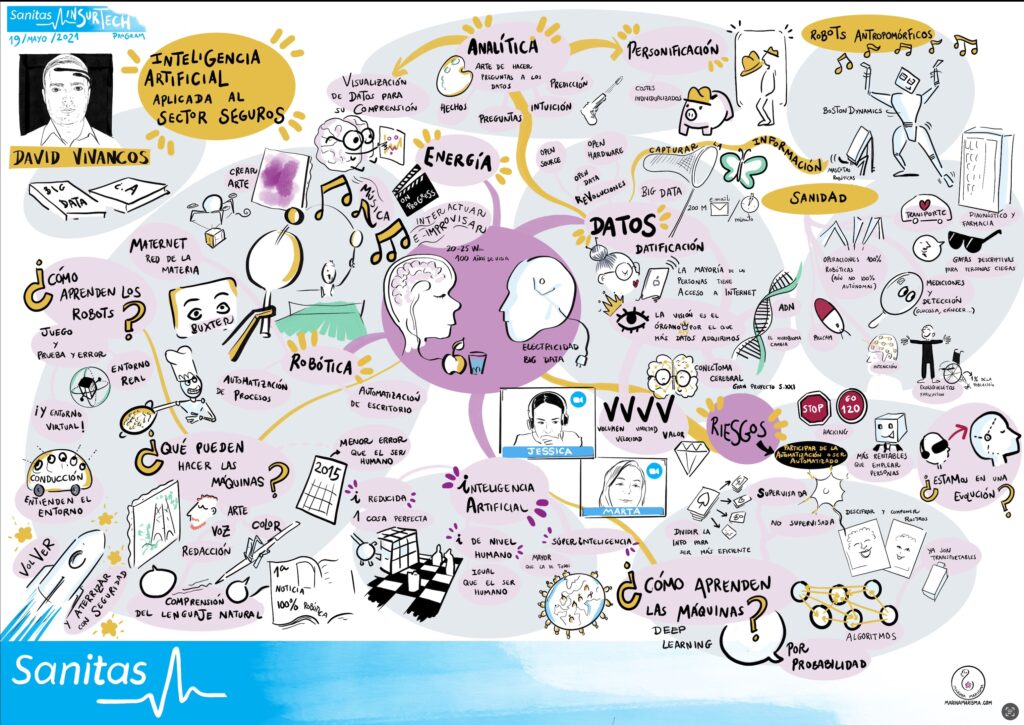
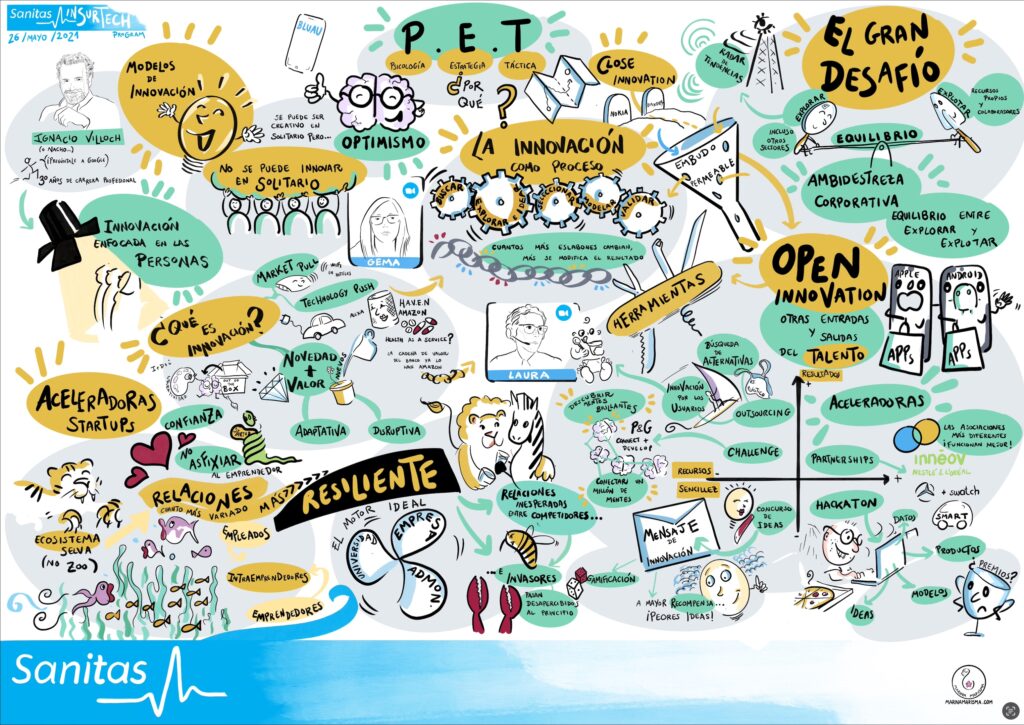
Hundreds, even thousands of people attending to hear the wise and expert words of the speaker, CEO, and keynote speaker, and the trust placed in the live illustrator to transform this speech into a fascinating, shareable, and memorable illustration.
There are many challenges, and one factor is decisive.
What is the narrative style of the speaker whose lecture you have to illustrate?
Based on my experience in the fascinating world of graphic recording, live drawing at events and meetings, I have grouped the skills and narrative styles of great speakers into these five broad categories, which are similar regardless of whether they come from fields such as artificial intelligence, cybersecurity, mental health, politics, healthcare, urban planning, or data governance, among many other fields in which I regularly work.
The first thing you need to know is that these brilliant minds are not only experts in their fields, but also have a distinct and justified storytelling style that captivates their audiences and, as a result, they are not only invited to conferences, but also hired.
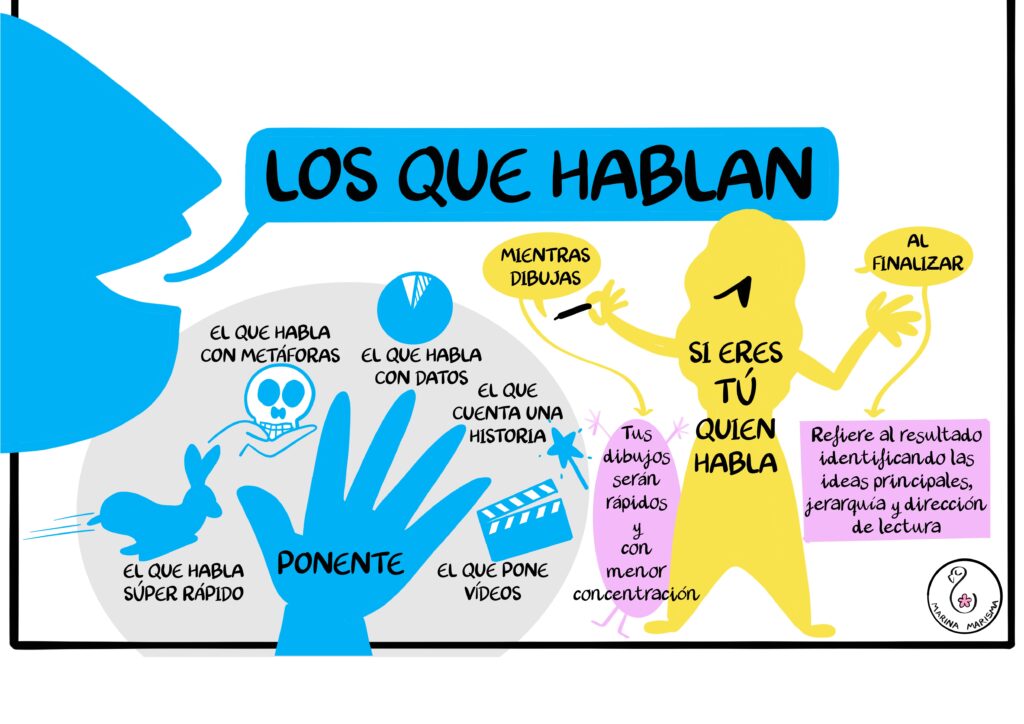
THE 5 TYPES OF SPEAKERS AT CONFERENCES, CONGRESSES, AND BUSINESS MEETINGS
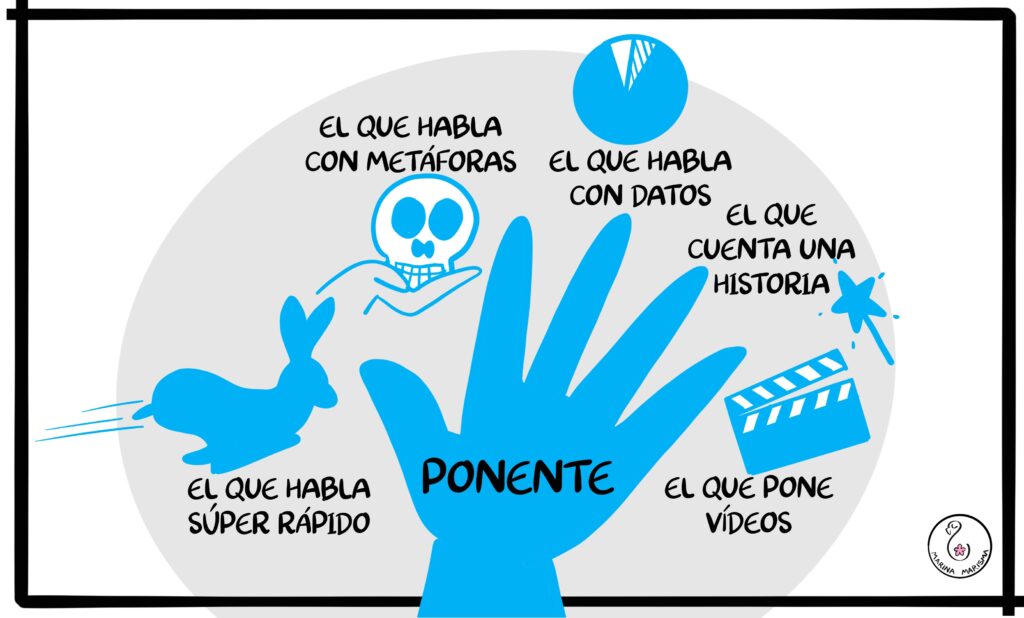
1. THE SPEAKER WHO SPEAKS SUPER FAST
I chose this speaker first because I clearly remember the first time I faced the challenge of drawing his talk and how it required all my mental effort, as well as my artistic skills.
That first meeting was a digital webinar, with no audience participation until the end of the talk, and when it was over, my client told me that throughout the speech he had been thinking, “Poor Marina.”
Poor? Not at all!
Thanks to him, I tested my skills, gained confidence, and learned how to approach other speakers who spoke along the same lines or at the same speed.
What is my advice here? The ability to synthesize is at the top of your list of skills to use. No matter how fast you speak, you are telling a story:
- Take a step back and look at this story from above: What is the message? What is the lesson? What details are really relevant for your drawing to be true to its message?
- Keep in mind that, given the speed of his words, he will share more knowledge than other speakers in the same time slot. Therefore, manage the space on your canvas.
2. THE SPEAKER WHO SPEAKS IN METAPHORS
Thank you.
A friend described my own narrative style to me, saying, “Marina speaks with drawings”
Well, I'm not the only one who does it.
I believe that speakers who use metaphors are actually visual thinkers (spoiler alert: we all are!).
I say “thank you” because, in my opinion, your choice of metaphors, not in the whirlwind and speed of the event, but in the preparation of your speech, makes our job much easier. If, in addition to speaking, you use these metaphors as visual aids (many do), we will be helping our audience twice as much to remember the story, by replicating these metaphors in our own style.
3. THE SPEAKER WHO SPEAKS WITH DATA
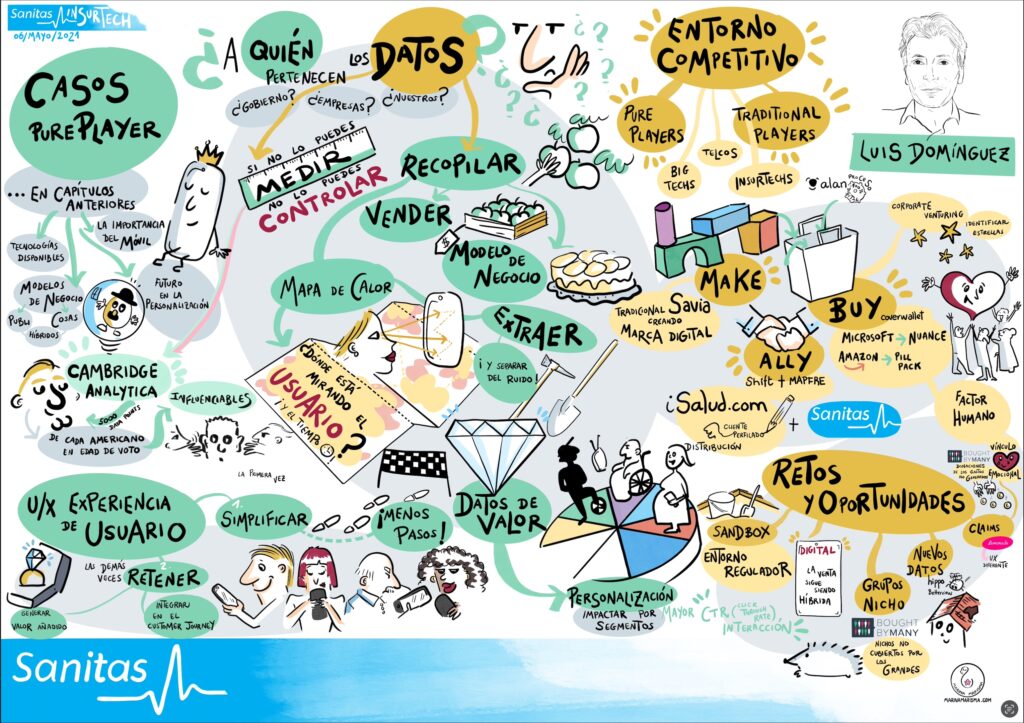
Drawing the data is a challenge in itself.
You probably have your own strategy, such as transforming this data into visual stories, for example:
- Transforming data into animal figures: elephant versus mouse
- Transforming data into recognizable references for people: the Eiffel Tower versus a small village house
- Represent data with data visualization: bars, pie charts, and other diagrams showing the substantial difference between different data sets.
Unless you have the information beforehand, accuracy may be compromised. You must be absolutely certain that the data you enter, if you enter it, is accurate.
The recommendation in this case is not to reflect the data as it is, but rather what the data means.
In other words, if “DATA KILLS STORYTELLING,” our mission is the opposite, which is that
“DATA BUILDS THE STORY.”
Representa lo que realmente se está contando: ¿Está aumentando la inflación? ¿Descendiendo la natalidad? ¿Qué sectores se están polarizando?
In summary:
WHAT THE DATA INDICATES
4. THE SPEAKER WHO TELLS A STORY
It is a real pleasure to listen to these speakers who have mastered the ancient art of storytelling.
You can choose between different formats to decide how to approach your canvas or how to ask your artist to represent it. If you want some tips, you can read this post: Vignettes? Flows? A single summary image?
My recommendation is to follow the story, capturing the imagery and magic that accompany it. In this case, the speaker respects the pace of our thinking as an audience, allowing us to draw with mastery.
But, like any good story, what is the message, the final moral?

5. THE SPEAKER WHO PLAYS VIDEOS
The one who projects videos, or the one who converses live and in real time with artificial intelligence.
In these cases, rather than telling us something, they are showing us and, in fact, demonstrating it.
Here, my recommendation is to represent what is happening. If it is a video, draw a summary of it (using your own technique, of course), and if it is an interaction, draw WHAT IS HAPPENING.
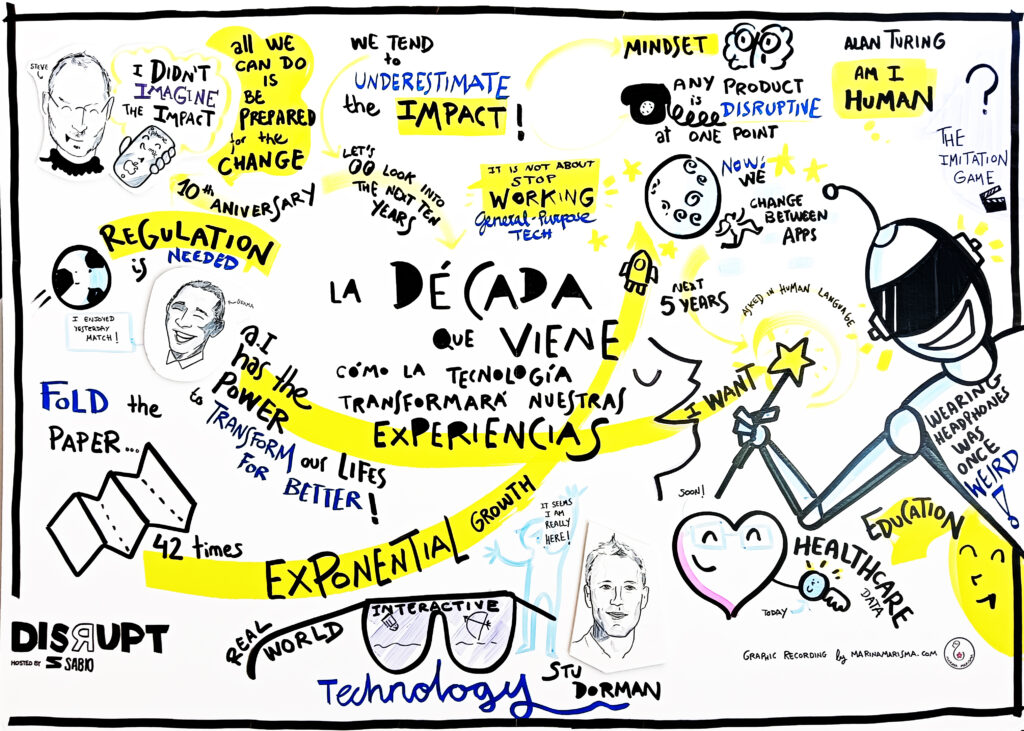
These interactions are often very entertaining and illustrative, so reenacting them will transport the audience back to this moment after the event.

IF IT IS YOU WHO SPEAKS
There are several cases in which the person who draws is also the one who speaks:
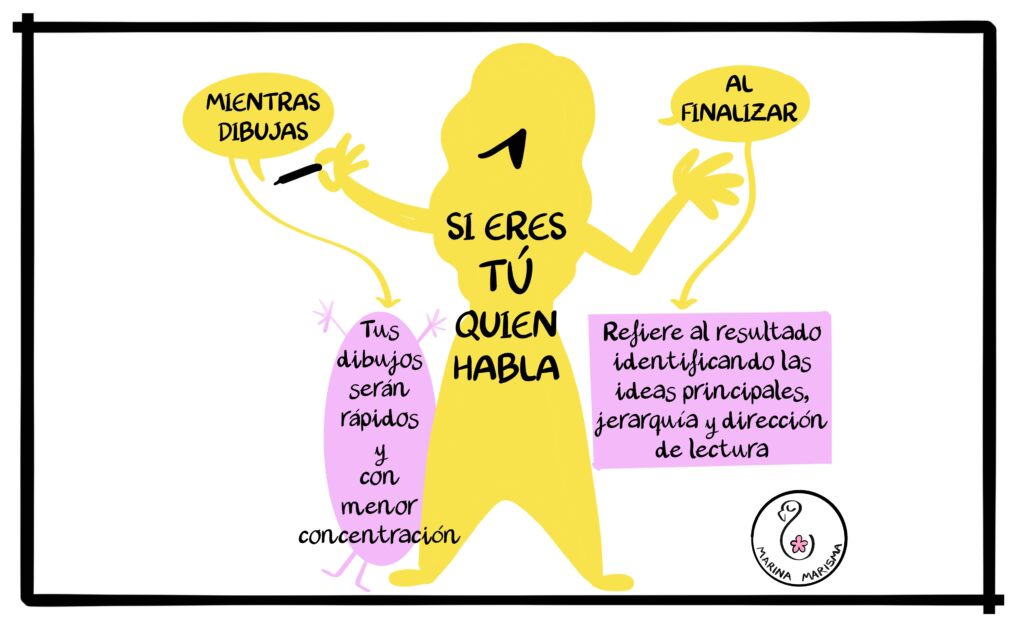
- If you are a speaker and use drawing and visual thinking to accompany your teaching, as do those who understand THE POWER OF VISUAL THINKING TO GET THEIR MESSAGE ACROSS TO THEIR RESPECTIVE AUDIENCES.
- If you are facilitating a meeting graphically, that is, leading the dynamics, explaining the procedures, and even recording the course and conclusions of the meeting
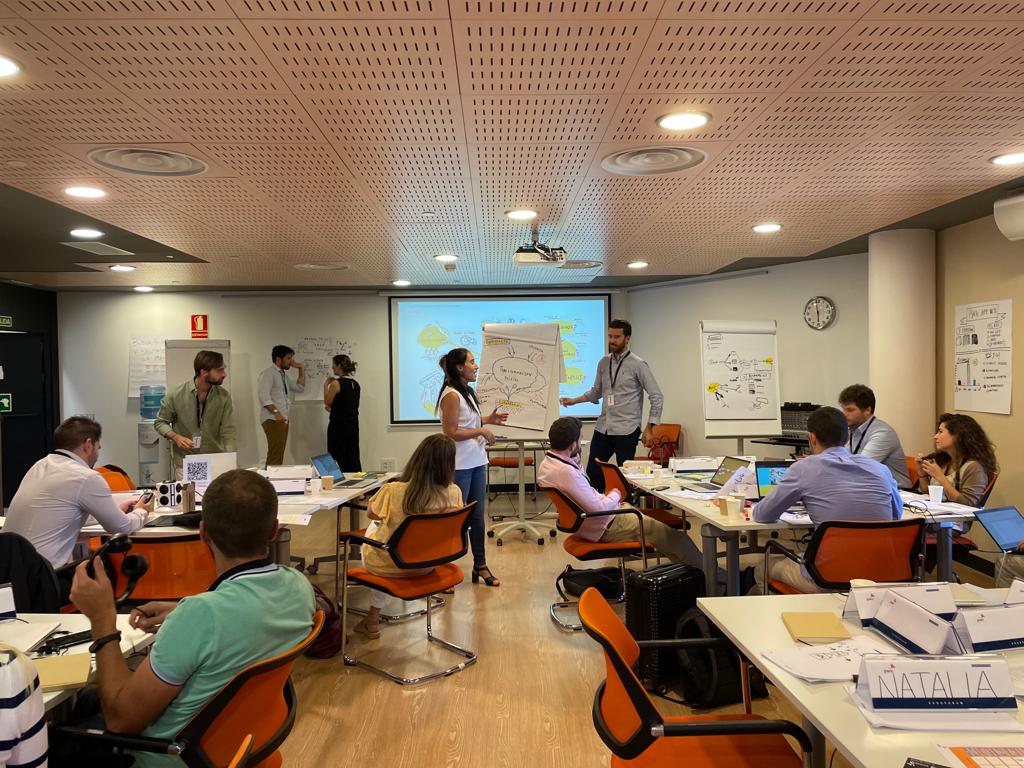
- If you are the graphic recorder, at the end of the session, explain how you drew it and summarize the content.
Es decir, dependiendo de tu rol o profesión, te puedes encontrar fundamentalmente en estas dos situaciones:
SPEAKING WHILE YOU DRAW
If this is the case for you, the first thing you need to know is that what is compromised is the quality of your drawing.
No la calidad del contenido, del mensaje, sino la calidad del dibujo propiamente dicho: el trazo, la grafía, la caligrafía.
In this case, you are like a schoolteacher. You cannot get distracted or devote all your attention to drawing the perfect picture, because you would turn your back, lose eye contact, and your concentration would no longer be focused on the message you are conveying.
In any case,
THE SUPPORT YOU PROVIDE IS ESSENTIAL FOR YOUR AUDIENCE TO
ATTEND, UNDERSTAND, AND REMEMBER
SPEAK WHEN YOU FINISH DRAWING
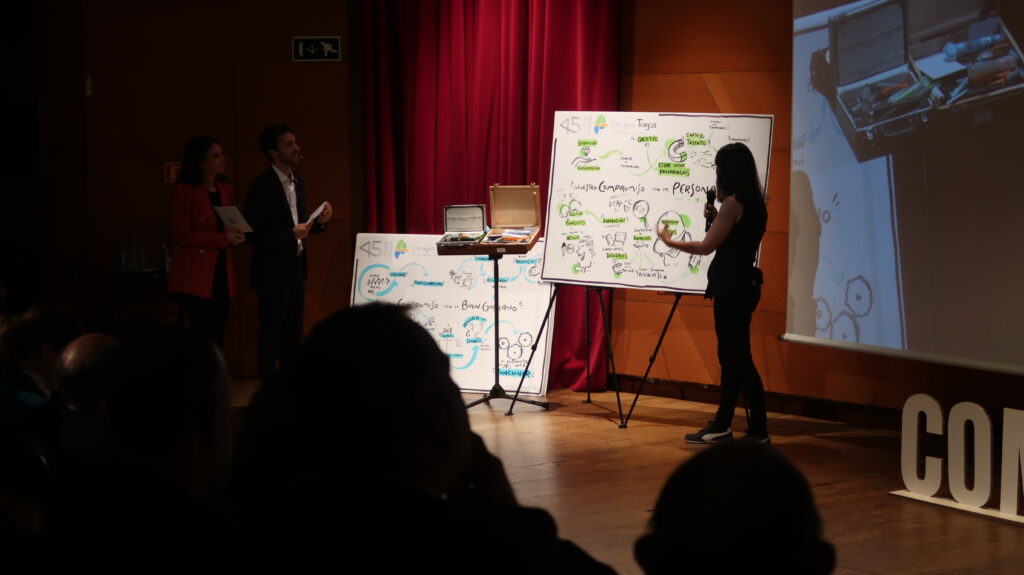
If your role in the discussion is passive, that is, you are not the one who speaks “during,” but you are asked to explain your drawing at the end of the work,
YOU HAVE THE UNIQUE OPPORTUNITY TO JOIN THE AUDIENCE IN READING THE CANVAS.
To do this, refer to the ideas you have represented, either by pointing them out or expanding on them (if you are working digitally).
If you have arranged your canvas with a specific reading direction, indicate this at this point as well, as it will help your audience to better understand and approach the drawing later on.
You don't need to recount everything you've represented, but you do need to recount the main ideas that have emerged during the event.
Now tell me,
¿CUÁL DE TODOS ESTOS PONENTES ERES TÚ?
I would be delighted to accompany you at your next conference, convention, or meeting with live idea sketching.
Contact me at
Marina.sanchez@marinamarisma.com
626158478
Marinamarisma.com
PS. This article is part of my book specializing in “I WANT TO BE A GRAPHIC RECORDER: The first interactiva guide to turning presentations/meetings/papers/ discussions into drawings, in real time.” available in
Spanish here:
and English here:


